Fit Foundation
Fit Foundation
  • Home
  • Events
    • Austin Solstice Circuit
    • Cedar Park Run A Mile
    • Fields of Gold Trail Run
    • Oasis Dash
    • Colorado River Run
    • Holiday Victory Lap
    • New Year Trail Challenge
    • Trails By Moonlight
    • Bluebonnet Trail Run
    • Austins Backyard Marathon
    • Rodeo Trail Run of Austin
    • Texas Backyard Series
  • Trackers
    • Mental Wellness Tracking
    • Mental Wellness Insights
  • Training Resources
    • Run A Backyard Ultra
    • Articles, Newsletters
    • Solstice Circuit Training
    • Donut Dash Training Pack
    • 25K Training Plan
    • Sub 4-Hour 26.2M Training
    • 50K Training Plan
    • 52 Mile Training Plan
    • 100-Mile Training Plan
    • Mental Training
  • About Us
    • About Fit Foundation
    • Sponsorships
  • Research and Reports
    • Health Impact Ratings
    • Survey & Reports
  • More
    • Home
    • Events
      • Austin Solstice Circuit
      • Cedar Park Run A Mile
      • Fields of Gold Trail Run
      • Oasis Dash
      • Colorado River Run
      • Holiday Victory Lap
      • New Year Trail Challenge
      • Trails By Moonlight
      • Bluebonnet Trail Run
      • Austins Backyard Marathon
      • Rodeo Trail Run of Austin
      • Texas Backyard Series
    • Trackers
      • Mental Wellness Tracking
      • Mental Wellness Insights
    • Training Resources
      • Run A Backyard Ultra
      • Articles, Newsletters
      • Solstice Circuit Training
      • Donut Dash Training Pack
      • 25K Training Plan
      • Sub 4-Hour 26.2M Training
      • 50K Training Plan
      • 52 Mile Training Plan
      • 100-Mile Training Plan
      • Mental Training
    • About Us
      • About Fit Foundation
      • Sponsorships
    • Research and Reports
      • Health Impact Ratings
      • Survey & Reports
  • Sign In

  • My Account
  • Signed in as:

  • filler@godaddy.com


  • My Account
  • Sign out

Signed in as:

filler@godaddy.com

  • Home
  • Events
    • Austin Solstice Circuit
    • Cedar Park Run A Mile
    • Fields of Gold Trail Run
    • Oasis Dash
    • Colorado River Run
    • Holiday Victory Lap
    • New Year Trail Challenge
    • Trails By Moonlight
    • Bluebonnet Trail Run
    • Austins Backyard Marathon
    • Rodeo Trail Run of Austin
    • Texas Backyard Series
  • Trackers
    • Mental Wellness Tracking
    • Mental Wellness Insights
  • Training Resources
    • Run A Backyard Ultra
    • Articles, Newsletters
    • Solstice Circuit Training
    • Donut Dash Training Pack
    • 25K Training Plan
    • Sub 4-Hour 26.2M Training
    • 50K Training Plan
    • 52 Mile Training Plan
    • 100-Mile Training Plan
    • Mental Training
  • About Us
    • About Fit Foundation
    • Sponsorships
  • Research and Reports
    • Health Impact Ratings
    • Survey & Reports

Account

  • My Account
  • Sign out

  • Sign In
  • My Account
Logo of Run A Backyard Ultra with Texas symbol.

Run A Backyard Ultra

Bastrop Last Standing

Rodeo Trail Run Backyard Ultra

Rodeo Trail Run Backyard Ultra

  Run on the same day as Autumn Harvest Trail Run.  


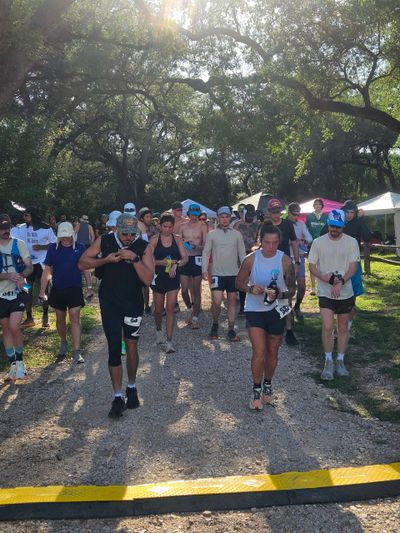
A 4.167-mile loop. Every hour, on the hour, you toe the line. Finish the loop in under 60 minutes and you get the time that's left to rest, eat, change socks, and stare at your shoes. Miss the bell by even a second  and you're done.The race ends when one runner is left standing.


The Right First Backyard

Bastrop Last Standing is built to be the most welcoming backyard ultra on the Run a Backyard Ultra Texas circuit. The course is honest: 141 feet of climb per loop, rolling singletrack along the lake, well-marked and well-shaded for an October date. The community is small and friendly. The bell is real.This is the right place to:

  • Run your first backyard ultra
  • Test the format without committing to a 24-hour race
  • Build toward longer backyards on the Texas circuit
  • Race something genuinely hard without it being inaccessible

Run until one runner remains. Bring your camp chair.


Course Details

  • Loop: 4.17 miles per lap
  • Elevation: ~141 feet of climb per loop
  • Terrain: Mixed singletrack near Lake Bastrop
  • Surface: Mostly runnable
  • First bell: 7:00 AM sharp


Race Day Logistics

  • Parking: On-site at Lake Bastrop South Shore Park.
  • Crew area: Set up your own aid station near the start corral. Camp chair, cooler, your nutrition, dry socks, whatever you'd want at hour 12.
  • Aid: This is a self-sufficient format. Water is available, but plan to bring your own fuel.
  • Packet pickup: Friday, October 9 at the venue.


Training for It?

We run a free weekly training plan for the Texas backyard circuit, 18 weeks of workouts, pacing strategy, and the mental playbook for the bell. Built specifically for Bastrop and the other backyards on our schedule.

[Subscribe to Last Standing →]


A backyard ultra is won at the rest chair, not the starting line. Most runners learn that the hard way. The newsletter is how to learn it before October 10.


Registration

[Register for Bastrop Last Standing →] 

Rodeo Trail Run Backyard Ultra

Rodeo Trail Run Backyard Ultra

Rodeo Trail Run Backyard Ultra

 The hardest backyard in Texas 


Spring season opener. Spicewood, Hill Country terrain. 


The natural next step after Bastrop, or a strong first backyard for runners who started training in late fall.


Bastrop runners, this is your next bell. Newcomers, this is your spring chance.


The Format

Same backyard rules. A 4.17-mile out and back. Every hour, on the hour, the bell rings. Run the loop in under 60 minutes, rest in whatever time remains, line up for the next one. The race ends when one runner outlasts the field.


Spicewood is Hill Country, more rolling terrain than Bastrop's lakeside course, more honest climbs per lap, more punishment in the back half.  


It runs harder than Bastrop or Marble Falls. The Hill Country climbs are longer. If Bastrop is the right first backyard, Rodeo is the right second.


Run laps until one runner remains, 


Course Details

  • Loop: 4.17 miles per lap
  • Elevation: ~ 50 feet of climbing per lap 
  • Terrain: Hill Country singletrack, exposed sections, climby, demanding, rolling climbs
  • First bell: 8:00 AM


Who This Is For

  • Runners building on a Bastrop finish
  • First-timers who started training in November/December
  • Veterans of the Texas backyard circuit looking for a spring opener
  • Trail marathoners curious about the backyard format (the marathon distance is your foot in the door)


Race Day Logistics

  • Parking: [On-site]
  • Crew area: Self-supported. Bring your camp chair, cooler, nutrition for 8+ hours.
  • Packet pickup: [Same day ]


Training for It?

The Last Standing newsletter runs continuously through the Texas backyard circuit. After Bastrop in October, training shifts toward Rodeo and beyond. 

Whether you're a first-timer or chasing your second bell, the weekly plan keeps you on track.

[Subscribe to Last Standing →]


Registration

[Register for Rodeo Trail Run Backyard Ultra →]

Austin's Backyard Ultra

Rodeo Trail Run Backyard Ultra

Austin's Backyard Ultra

Memorial Day weekend. Texas Hill Country at the edge of summer. 


The closing bell of the Run a Backyard Ultra Central Texas backyard season.


The Format

A 4.2-mile loop. Every hour, the bell. Run, rest, repeat, until one runner is left standing.

The late-May sun is unforgiving, and the field that shows up tends to be experienced. 


This is where the season's serious runners come to close out their winter-spring training cycle.


Who This Is For

  • Runners closing out a backyard season that started at Bastrop in October
  • Experienced backyard veterans looking for harder terrain
  • Memorial Day weekend runners wanting their training to mean something beyond a finish line


Course Details

  • Loop: 4.2 miles per lap
  • Elevation: [~180 ft climb per lap]
  • Terrain: Marble Falls Hill Country, exposed, climby, mixed surface 
  • First bell: 7:00 AM
  • Sunrise/sunset: Long daylight hours this time of year, most runners finish their day in light


Race Day Logistics

  • Parking: On-site 
  • Crew area: Self-supported. Bring shade, extra water, electrolytes for warm weather.
  • Packet pickup: [Day-before and same day]
  • Heat note: Late May in Marble Falls runs warm. Plan your kit and hydration accordingly.


Training for It?

The Last Standing newsletter trains backyard runners through the full Texas circuit. 


If you're targeting Austin's as your A-race, the plan ramps from January through May with you in mind.


[Subscribe to Last Standing →]


Registration

[Register for Austin's Backyard Marathon Ultra →]

Master the Clock

Step Up to the Line

 The beauty of a last-person-standing format is that it rewards strategy, consistency, and pacing over sheer, blistering speed. To prepare your body and mind for the 4.167-mile hourly loop, your training shouldn't look like a traditional marathon plan. You need to train your brain to accept the rhythm of the clock: running a loop, resting, and restarting on the exact start of the next hour.  

The last-person-standing format meets you exactly where you are. You don't have to beat a professional athlete's pace; you just have to manage your own clock and outlast your own doubts. 

Whether your goal is to finish 3 loops, achieve your first official ultra distance at 32 miles, or push past 100 miles into day two, the format provides the ultimate supportive environment. You return to the base camp every single hour to the cheers of friends, family, and fellow runners. 

Commit to the process, trust your pacing strategy, and sign up today to find out exactly how many hours you have inside of you.

This 18-Week Training Roadmap built specifically for the Backyard format. It is designed to take the intimidation out of the distance, build your confidence, and ensure you line up ready to conquer the clock. 

The Training Principles

  • The Mixed-Gait Approach: Do not run your entire long run. Practice power-hiking the steeper inclines and jogging the flats and downhills to conserve energy.
  • The "Dead Air" Routine: During your back-to-back long runs, explicitly practice finishing early, sitting down for 8 to 12 minutes to refuel, and forcing yourself back up when the timer buzzes.
  • Active Recovery: Focus heavily on mobility and structural strength to survive the constant transitions between movement and stagnation.

Training Roadmap

 Phase 1: Base Building & Aerobic Conditioning (Weeks 1–6)

The objective here is simple: build structural durability in your joints and lower your heart rate. Your pace does not matter; your time on your feet does.

 Phase 2: Mixed-Gait Mastery & Heat Adaptation (Weeks 7–12)

Texas summers require respect. Instead of fighting the heat, use it to your advantage to build superior cardiovascular efficiency. This is also when you should master the art of walking.

 Phase 3: Peak Volume & Specific Simulations (Weeks 13–15)

This is the most critical phase of training. Practice the specific logistics of the race: gear changes, nutrition pacing, and lighting transitions.

 Phase 4: Sharpening & Taper (Weeks 16–18)

The work is done. Your only goal now is to arrive at the starting line feeling fresh, hungry, and completely recovered.

Base Building & Aerobic Conditioning (Weeks 1–6)

 The Weekly Routine

  • 3 short, easy midweek runs (3 to 5 miles) keeping your breathing completely relaxed.
  • 1 weekly strength session focusing on single-leg stability (lunges, step-ups) to handle the rolling terrain of Lake Bastrop. 
  • The Weekend Milestone: A back-to-back weekend. Saturdays feature a long, relaxed trail jog/walk combo (starting at 6 miles and building to 10). Sundays feature a 4-to-6 mile brisk recovery walk on tired legs.

Mixed-Gait Mastery & Heat Adaptation (Weeks 7–12)

The Weekly Routine

  • Midweek runs focus on consistency. Introduce 1 hilly session per week to practice efficient power-hiking techniques.
  • The Weekend Milestone (The Hourly Habit): Start introducing the 1-hour interval concept during your Saturday long sessions.
    • Example: Run 4.167 miles, note your time, and force yourself to rest until the next hour begins. Start with 2 loops this month and progress to 3 loops by late next month. Use this phase to learn your natural pacing on single-track trails. 

Peak Volume (Weeks 13–15) Sharpening & Taper (Weeks 16–18)

The Weekly Routine: 

Maximum mileage, focusing heavily on back-to-back weekend trail efforts.

  • Week 13: 4-Hour Simulation. 4 loops on the hour. Practice your nutrition plan, eating small, 150–200 calorie snacks during your 10-minute rest windows. 
  • Week 14: The Night Shift Prep. Start a 4-loop simulation at 5:00 PM. The final loops will require a headlamp, mimicking the transition you will face at Lake Bastrop when the sun sets. 
  • Week 15: Peak 5-Hour Simulation. 5 consecutive loops on the hour. If you can complete this, you have the physical capability to push well into ultra-marathon territory on race day
  • Drop your overall weekly mileage by 30% in Week 16, and another 30% in Week 17. Keep your moving days short, crisp, and relaxed.
  • The Weekend Milestone: Short, low-impact trail walks or jogs (under 5 miles) to keep your muscles loose without creating new fatigue.
  • Race Week: Focus entirely on sleep, high-quality hydration, and organizing your race-day basecamp bin (extra socks, change of shoes, anti-chafing lube, headlamps, and your preferred fuel). . 

The 4-Week Training Layout

This 4-Week Foundational Training Block is designed to build the specific endurance and logistical habits needed to find success on the trails. 

Week 1: Establishing the Rhythm

  •  Monday: Rest & Active Mobility (Focus on hips, calves, and ankles).
  • Tuesday: 5 Miles Easy Road or Flat Trail. Focus on a steady, relaxed pace.
  • Wednesday: 45-Minute Hill Repeat Session. Power-hike up with strong strides, then run down smoothly.
  • Thursday: 4 Miles Recovery Pace + 15 Mins Core Stability work.
  • Friday: Rest Day. Clean gear, hydrate, and prep your fuel.
  • Saturday (The Simulation): 3-Hour "Backyard" Simulation.
  • Protocol: Set an alarm for the top of every hour. Run exactly 4 miles, aiming to finish in 48–50 minutes. Spend the remaining 10 minutes sitting in a chair, drinking electrolytes, and eating a small snack. Repeat 3 times.
  • Sunday: 6 Miles Easy Recovery Walk/Trail Jog. Moving on tired legs.

Week 2: Building Volume & Gear Testing

  •  Monday: Rest & Foam Rolling.
  • Tuesday: 6 Miles Aerobic Base Run (Keep heart rate firmly in Zone 2).
  • Wednesday: 50-Minute Trail Session. Focus on moving smoothly over technical roots and rocks.
  • Thursday: 5 Miles Recovery Pace.
  • Friday: Rest Day.
  • Saturday (The Double Down): 4-Hour "Backyard" Simulation.
  • Protocol: 4 loops of 4.167 miles, starting exactly on the hour. Use this day to test your race-day hydration, anti-chafing strategy, and shoe selection.
  • Sunday: 8 Miles Slow Trail Run/Hike Combo. Keep the effort intentionally low, mimicking how you will feel deep into a race.

Week 3: Peak Volume & Night Simulation

  •  Monday: Rest & Deep Stretching.
  • Tuesday: 7 Miles Aerobic Base Run.
  • Wednesday: 60-Minute Hilly Trail Run. Practice efficient descending without pounding your quads.
  • Thursday: 5 Miles Easy Road Run.
  • Friday: Rest Day.
  • Saturday (The Night Shift Prep): 5-Hour "Backyard" Simulation (Varying Light).
  • Protocol: Start your 5 hourly loops in the late afternoon so that your final two loops require a headlamp. Managing shadows, foot placement, and depth perception under a headlamp is a crucial skill for the evening hours.
  • Sunday: 10 Miles Power-Hike. Zero running allowed. Focus entirely on a fast, efficient walking gait to build low-impact endurance.

Week 4: The Taper & Mental Reset

  •  Monday: Rest & Recovery.
  • Tuesday: 4 Miles Light Trail Jog.
  • Wednesday: 30-Minute Easy Movement.
  • Thursday: Rest Day.
  • Friday: Rest Day (Pack your race bin: extra socks, layers, headlamp, and favorite snacks). 
  • Saturday: Race Day!

Logo of Run A Backyard Ultra with Texas symbol.
  • Mental Wellness Tracking
  • Mental Wellness Insights
  • 25K Training Plan
  • 50K Training Plan
  • 52 Mile Training Plan
  • 100-Mile Training Plan
  • Mental Training
  • Health Impact Ratings
  • Race Austin Series

Fit Foundation

6501 Avenida Ann Drive, Lago Vista, Texas 78645, United States

Tel: 7378434614 Email: info@atxactive.com

Copyright © 2024 Fit Foundation LLC - All Rights Reserved.

Powered by

This website uses cookies.

We use cookies to analyze website traffic and optimize your website experience. By accepting our use of cookies, your data will be aggregated with all other user data.

Accept